


From https://movimentodosirmaos.blogspot.com/p/blog-page.html
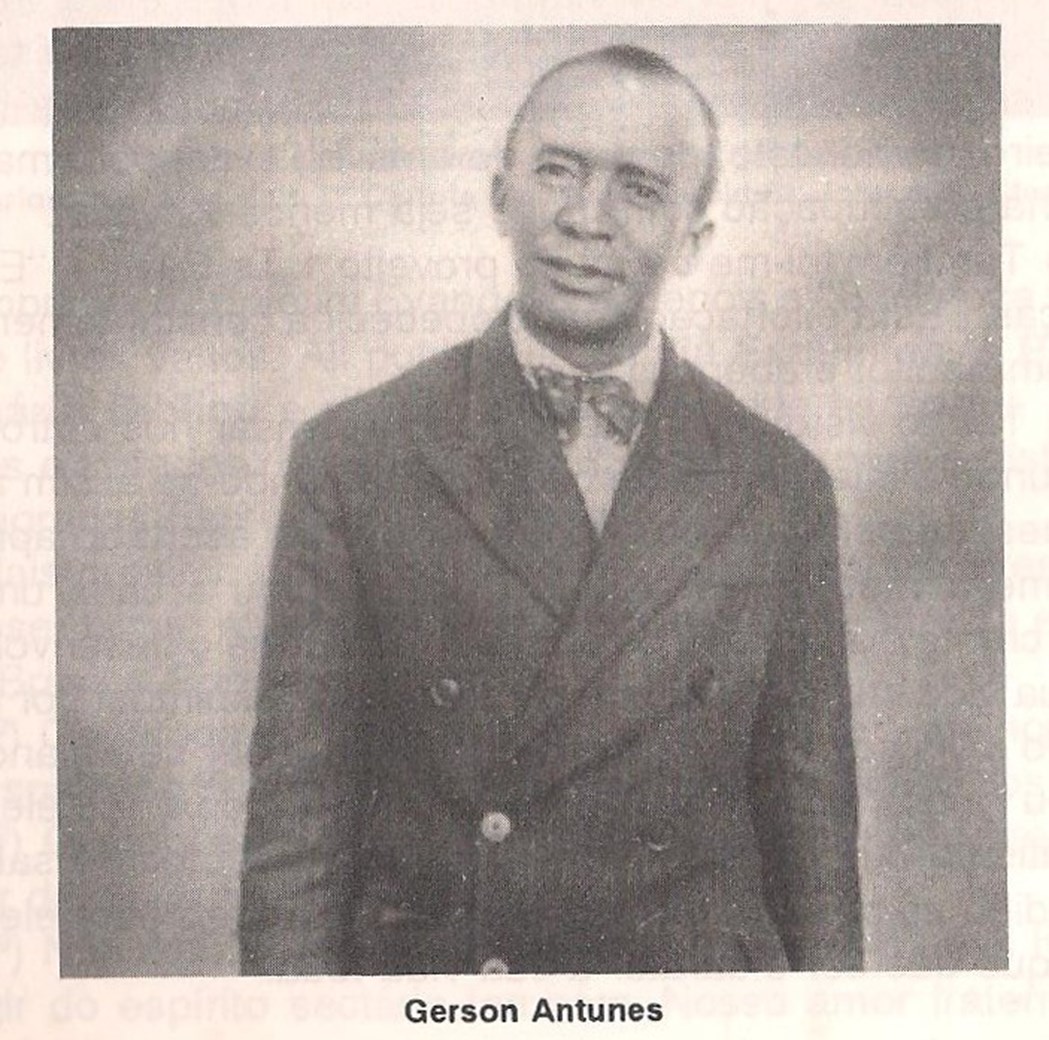
Gerson Antunes was born on August 6, 1889, in Caxias, state of Maranhão.
Coming from a poor family, perhaps descended from slaves, everything indicates that he had access to some education, since he sometimes wrote for a newspaper in his city and had a good knowledge of music. He played the piston (a type of flute).
All we know about his family is that he left behind two sisters in Maranhão.
While still very young, he had to leave his city because he dared to write an article in a local newspaper against a judge who had rigged an election. To avoid being arrested, he fled to São Luís, the state capital. Not feeling safe there, he took an "Ita do Norte," a traditional type of ship, and went to Salvador, Bahia.
With limited resources, he accepted a job at a barbershop, where he didn't adapt well, given his lack of dexterity with his hands.
After quitting his job, he wandered the streets of Salvador, eventually joining a group of bohemian musicians. And, through serenades, he grew accustomed to drinking, eventually becoming addicted to alcohol.
He lived off the generosity of his bohemian companions and the little he earned playing his piston in the city's bars. As a result, he found himself in a very difficult situation; his clothes were in poor condition, his shoes were worn out, and he was on the path to becoming just another beggar in the city of Salvador.
Sometimes, when he remembered that phase of his life, he would say, emotionally: "I even resorted to picking up cigarette butts in the streets to smoke."
Thus, in this deplorable state, he wandered the streets, drinking from bar to bar, for there was no shortage of people who would buy him a drink.
One Sunday evening, while walking down a street quite drunk, he heard a melody being sung. As he was a great lover of music, he tried to find out where the song was coming from.
It was a House of Prayer (Meeting Hall), where a choir was singing a hymn. He was invited and given a seat. At that moment, he could only appreciate the music, as the alcohol prevented him from properly understanding what was being said.
Drawn by the music and the way he was treated, he returned. Now, no longer so drunk, he was able to hear and understand the sermon. The one preaching was Brother Edward Percy Ellis. He was speaking about Elijah and the prophets of Baal, reading from 1 Kings 18.
The preacher spoke about verse 21, which asks: “How long will you waver between two opinions? If the Lord is God, follow him; but if Baal is God, follow him.” These words deeply affected him, giving him no peace.
After several days of reflection, he answered the question, surrendering himself to the Lord Jesus to follow and serve Him for the rest of his life. God used the song of a choir to transform that life which was falling into the darkest perdition; perdition of physical life and, what is more terrible, perdition of the soul.
He said, "He pulled me out of the deepest abyss."
That's why he appreciated choirs so much, organizing good choirs in some of the places where he lived.
Mr. Eliis took an interest in him, seeing that, despite having fallen so far in social life, he was an intelligent person of good principles.
Mr. Ellis owned a pharmaceutical sales office in Salvador and employed Gerson Antunes at his business.
Around 1918 or 1919, Mr. Ellis moved to Rio de Janeiro, bringing Gerson Antunes with him as his employee.
In 1920, Mr. McNair, living in the rural area of Conceição de Carangola, MG, promoted the third Bible School there, giving several young believers the opportunity to study the Word of God and also receive some instruction. There they had the privilege of receiving teachings from great scholars of the Word of God, among them the renowned Harold St John, who, in addition to being very learned, was, above all, a consecrated and pious servant of the Lord.
At the end of the four-month school term, the students of the Bible School received a letter from Joaquim Paulo de Oliveira requesting a visit to Barreiros, where the Gospel was beginning to spread. Gerson Antunes and Joaquim Alves Mafra agreed to make the visit.
The Gospel in the municipality of Itaperuna and the surrounding region began in 1913, with the collaboration of brother Alfred Gonçalves Filgueiras. In that locality, an evangelical work began which soon expanded with the conversion of Virgílio Tinoco Machado, who owned a farm in Barreiros, Valão, and even reached the city of Itaperuna.
With his visit to Barreiros, Gerson became known to the believers in that region.
As soon as he finished his time at Bible School, Gerson Antunes returned to Rio de Janeiro.
Some time later, brother Ellis ended the business, as he needed to dedicate himself more to the growing work of the Gospel in that city, leaving brother Gerson unemployed. Because he showed skill as a teacher, around 1927 he was invited by Joaquim Paulo de Oliveira to teach his children and other children from the farm and neighboring areas. Thus, Gerson Antunes went to that region. He taught secular subjects and cooperated with the Lord's work, preaching the Gospel and teaching biblical doctrines to those who wished to join the ministry.
He married Herondina Bastos in 1928; she was the daughter of a farmer on the same farm where he taught.
In January 1929, their first son, Eleazar, was born. They had three more daughters: Tirza (who died in infancy), Milca, and Naltina.
In 1930, with the coffee crisis, many families, mainly from the Valão region, moved to Rio de Janeiro or the Rio Doce region, resulting in a shortage of students. Since Barreiros offered better living conditions and therefore a larger number of students, he chose to move there. He opened a school opposite the main house of the farm, next to the house where he lived.
With Mr. Mc Nair 's move to Teresópolis in 1933, the Association of Houses of Prayer took over the property he had acquired on the hill behind the "Casa de Oração" (House of Prayer, Meeting Hall) where a residence and a shed were built to house itinerant workers, as well as a Bible study room. Gerson Antunes took up residence there, teaching a basic course for the children of the region and also organizing the Evangelical Institute, where many young men came to study not only, and primarily, biblical truths, but also the basics of the language to better perform the Lord's work. He worked there until 1934, cooperating with the Church in teaching the Word and in evangelization. He formed, as he had already done in Valão, a large choir, taking the sung message to many places.
In 1935, the directors of the Evangelical Institute found it convenient to transfer it to Carangola, MG. Professor Gerson, as director, moved there in January of that year. The Association acquired a plot of land there, approximately three alqueires (approximately 7.26 hectares), which included a large house. They built dormitories for boarding students, a refectory, a kitchen, and a classroom. This property was located two kilometers from the city center.
The Carangola Bible Institute operated until 1939. With the outbreak of World War II in September of that year, many students had to return to their places of origin, and resources for maintaining the organization became more difficult to obtain.
Since Professor Gerson, despite being self-taught, was proficient in languages and had a good command of English, his brother Alfredo Gonçalves Filgueiras , who was the owner and director of the Academia de Comércio (Academy of Commerce) in Vitória, Espírito Santo, invited him to teach English at his school. Thus, he moved to Vitória, Espírito Santo, in early 1940. There he worked teaching and cooperating with the work of his brothers that was developing in that city.
His wife fell ill and he, who had been suffering from hypertension for some time, saw his health condition worsen.
As his and his wife's illnesses worsened, he wrote to his brother Joaquim Alves Mafra, with whom he had become very close, asking him to come and get him. Thus, in March 1943, his brother Joaquim Mafra went to Vitória and took them to Itaperuna. A house was rented for his wife Herondina, who was already terminally ill, and she stayed with her mother, Dona Rita, and another person who cared for them. Professor Gerson stayed at Joaquim Mafra's house. He was already blind, with difficulty walking, speaking, and even swallowing.
Despite all the physical and emotional suffering, due to being separated from his wife, he never complained and, in moments when the pain eased, he appeared cheerful, trying, even with difficulty, to impart some knowledge to those who assisted him.
A former student wrote to him saying that he “kept wondering why such a devoted servant suffered so much?” Then he, who could no longer write, asked him to reply to the letter saying: “Don’t ask why, but for what purpose.”
Herondina passed away in June 1943, three months after arriving in Itaperuna. Professor Gerson stayed at his brother Joaquim Mafra's house until August of that same year, when he was taken to Barreiro, where he said he wanted to die. There he stayed at the house of Jaime Tinoco Resende, where he passed away on September 9, 1943.
He was a great scholar of the Scriptures and had a special gift for transmitting them. He was also a faithful servant. He always lived with the desire to serve the Lord, seeking to pass on, especially to the youth, what he learned in the study of God's Word. Today, we are certain, he has already received from the Lord... "Well done, good and faithful servant... enter into the joy of your master."
From Gerson Antunes' work, we can highlight the composition of some hymns and the translation of others. Among them are, in the Hymnal Hinos e Cânticos (Hymns and Songs), composed by him: Eternidade (nº 106); Jesus o Senhor (nº 397); Maravilhoso Senhor Jesus (nº 443) and his translation of the hymns: Os meu pecados todos (nº 387); A Beleza de Cristo (nº 756) and a separate hymn: Um Dia no Calvário.
----------------------------------------------------------------------------------------------------------
Biography of Gerson Antunes by Dario Boechat Pinto: https://www.brethrenarchive.org/people/dario-boechat-pinto/pamphlets/pt-br-perfil-de-gerson-antunes/
